
The Painter and the Stranger
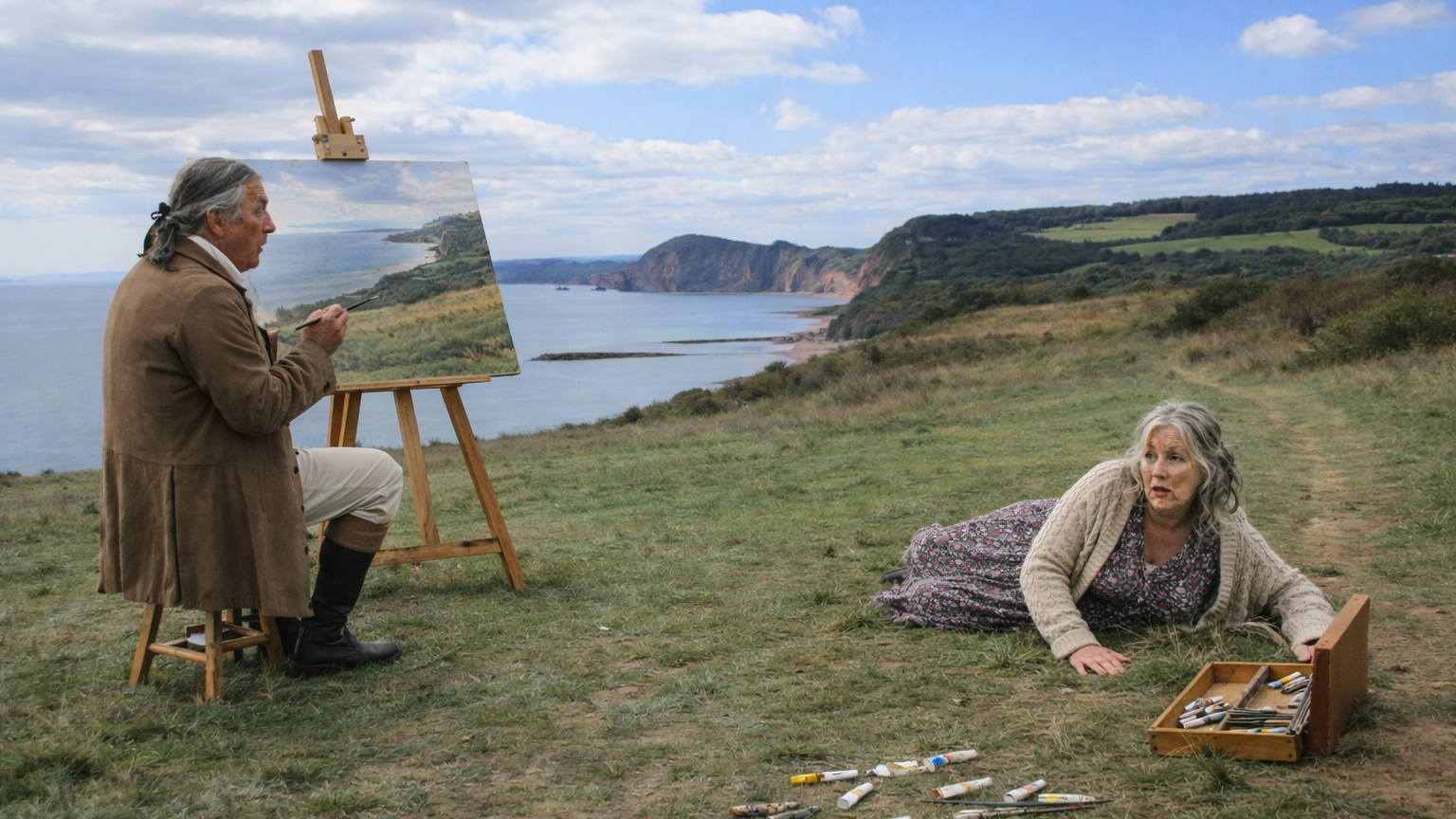
In the split second that Beatrice Hart began to fall, she felt like an utter fool.
Over recent years, one by one, her friends had left Surbiton, some to be nearer their children, and others to escape the traffic and the dull atmosphere. Some had died, Jeff among them.
Widowed at sixty-seven, she said her goodbyes to her solid and dependable husband, and her carefully ordered life had folded in on itself.
There was no reason to stay in Surbiton. She was rattling around in a large Edwardian semi that was chock full of painful memories and far too big for one person.
“D’you want me to help you find a flat round here?” asked her son, Alex, who was living in Cardiff with his girlfriend Lizzie.
“Send me anything you think I might like,” she replied.
Beatrice put the house on the market, with every intention of moving to Wales, but no sooner than the sale was agreed, she started worrying that it was too much of a risk to go to Cardiff. It would be awful to get stranded there on her own if Alex’s job took him elsewhere. You can never tell with children.
“I’m going to rent for a while,” she told him, “somewhere in Devon, I think. I’ll see how I feel after that.”
But she had already made up her mind. She wanted to settle somewhere where she could paint and rediscover herself, not somewhere where she would only be half a person, trailing around after one of her children.
She wanted, oh, so very much, to set her easel up by the sea, and to bury herself in the waves, the weather, and the sky, in all their varied moods, until the weight inside her chest dulled and she could breathe again.
She found a small cottage tucked into the corner of a courtyard near the centre of town and signed a two year agreement with the letting agent.
Sidmouth was welcoming in the way seaside towns often are. The shopkeepers were friendly, dog walkers stopped to chat, and she joined the Society of Artists. She had planned to prove to herself that she could still be independent and strong, but somehow, the kinder people were, the lonelier she felt. She found herself smiling politely, going through the motions of civility, then retreating, her shell as thick as ever.
One bright April morning, she set off up the South West Coast path with her sketchbook and climbed Salcombe Hill, the path steep and sandy underfoot. Eventually, she paused to breathe, turning to admire the view materialising behind her. The sultry red cliffs of High Peak provided the perfect counterpoint for the beach below. The town, with its patchwork of white hotels and green gardens seemed to be flattened like a giant’s thumbprint. The only movement was the broken line of people flowing along the esplanade like so many ants, and the twinkling of the sea.
As Beatrice turned back, suddenly her foot slid on the loose sand. She fell dramatically. One thought flew through her mind as she pivoted, wide-eyed, “You ridiculous woman!” Instinctively she flung out her arms to protect her easel and art case, then her face thudded into the ground, light bursting behind her eyes.
When she came to, her mouth was smeared with gritty red sand. She rolled over and sat up slowly. A man had been sitting on a stool nearby, an easel beside him, and a wooden box at his feet. He had leapt to his feet but seemed hesitant to approach. He was looking at her with deep concern and something akin to embarrassment. His buttoned coat was well-fitted, and his dark, wavy hair was tied back with a ribbon. He looked for all the world like he was an extra in a TV show, Poldark perhaps. He was holding a brush, still loaded with wet paint, and a sudden drip seemed to bring him to his senses.
“Madam,” he hesitated, “Are you injured?”
“I, er, I don’t know,” stammered Beatrice, wiping her mouth with the back of her hand and touching her fingers to her smarting forehead.
Her heart was hammering, and she felt sick with shock, but other than that she didn’t seem to be hurt.
His gaze lingered awkwardly, but not unkindly. “Do you wish me to help? If you will allow me?”
He came towards Beatrice and offered his hand, but she shook her head.
“I just need a sec,” she said.
His eyebrow lifted for a moment, and his gaze travelled down towards her ankles. Feeling singularly unsettled, she tugged her dress further over her knees and pulled her thick cardigan more tightly around her. “I’m from London,” she blurted. It was the first thing that came to her, and it seemed utterly absurd, but it was all she had to offer.
It was then that her attention was caught by the screeching of a seagull, and for the first time she looked beyond the flamboyantly dressed artist and noticed the view behind him. The general outline of the landscape was the clearly the same, but Sidmouth itself was completely different.
There was no sea wall, and the tidy, paved esplanade was gone, and there were men on horseback and horse-drawn carriages where there should have been cars. She could see a tall pillar of stacked rocks in the sea, where there had been none before. There were two or three large houses, pale and pristine in the sunshine, and a smattering of smaller ones, some of them thatched. A few fishing boats were clustered on the strand, and she could see several old-fashioned sailing ships on the horizon. Another wave of nausea engulfed her.
“I’m sorry,” she stuttered, “I’m feeling a bit disoriented.”
The man looked somewhat bemused himself.
“I’m Beatrice Hart,” she added, “Um, I was widowed recently.”
The explanation was as much for herself as for him.
The quizzical expression remained evident on the man’s face, but he nodded and affected a polite bow. “My apologies, I have not introduced myself. James Faraday. If you are certain that all is well, pray sit as long as you wish, but I must continue with my work. I am engaged upon a most pressing commission.”
The strange painter returned to his easel, Beatrice stared at the view, at the impossibility of it all. This scene was long before her own time. Before Jeff. Before trains. Before photography. A quiet inner voice thrummed, telling her all she needed to know. Perhaps she had concussion. Or she was unconscious. But there was nothing to be done about it.
A few minutes passed in silence. Although her mind was still in a whirl, she began to feel capable of standing.
“May I see your work?” she asked, hoping to anchor herself in this strange new reality.
James smiled. “By all means, madam.”
She looked at his painting. It was meticulous and almost architectural in style and detail. The village was represented with care, each roof and window a small piece of perfection. It was beautiful, but it made her uncomfortable.
“You’ll be here all day. And the light is changing, is it not? Didn’t you say this commission was urgent?”
“If Sidmouth is to become a successful sea-bathing resort, as my patron desires, it must be seen in the best light.”
Beatrice stifled a short snort of surprise. James frowned, and something sparked in his eyes. Not irritation. Confusion, perhaps, or was it curiosity?
Beatrice soon recovered and after a while she felt well enough to set up her own easel. She chose a spot far enough away to show respect for the stranger’s personal space, but still close enough to exchange a pleasant word or two. When it became too dark to work, they stopped to examine each-other’s paintings with practiced eyes and offer some constructive criticism. Beatrice was gratified to achieve a steady tactful chat with James. He wasn’t as closed off as some artists she knew.
Later, as James walked down into the village, Beatrice followed close behind, hungry and somewhat afraid. Her clothes were attracting stares, and she had no idea where she might stay, or how she could pay. She told James she had lost her bag on the way to Sidmouth and asked whether he could recommend a pawnbroker who might accept some jewellery, but he said that there was nothing in Sidmouth of that kind. Instead, he suggested a respectable lodging house near his studio, where the landlord, who was a fair man, might oblige her.
The kindly landlord offered her a small room with a feather bed and even supplied a clean dress belonging to his daughter. Beatrice parted with her wedding and engagement rings in return. She watched the gold disappear into the landlord’s pockets with detached calm. It was only a dream, she reminded herself, and there was no harm in it.
The next day she was on the way to the beach when she saw James leaving his studio with his paint box and easel, heading in the same direction. He tipped his hat. “Sidmouth agrees with you,” he commented approvingly, as he appraised her new dress.
Over the following weeks, they found themselves at the same places again and again: a bend in the river, a viewpoint on Peak Hill, or a sunny spot by Chit Rock. An easy friendship grew between them. When Beatrice looked at the canvases James painted, she felt a tug of admiration and awe. When he watched her throwing down loose and fulsome strokes, his eyes softened with something like hunger. There was no agenda between them, just a warm and gentle camaraderie.
Beatrice always propped one or two completed works beside her when she was out on the strand, hoping to drum up custom. At first, her bold, painterly work was met with a mixture of confusion and criticism, but she had no choice. Beatrice needed to sell her canvases as souvenirs in order to survive.
“Very spirited,” said one matron, her lips pursed. “Unfeminine,” whispered another. But as the spring edged towards summer, her work found an eager market amongst the steady flow of fashionable young visitors.
The flood came in June, after two days of rain. Beatrice woke suddenly to the sound of shouting and panic in the street. The River Sid had risen overnight, roaring and sweeping down to the sea. In the half light, the villagers were rushing from house to shore, intent on pulling the fishing boats further up onto the shingle or saving whatever possessions they could from the deluge.
There was only one place Beatrice wanted to be. She dashed along the muddy street to James’s studio. The flood water had overflowed the gulleys and had breached the footings of his building. James was already inside, lifting his canvases from where they had been leaning against the studio walls, and hauling them up onto tables and shelves, propping them up with space in between them so they could dry out. Beatrice set to work alongside him, gasping with horror at the damage to the bases of some of the paintings, with their smudged and bleeding colours.
They worked side by side, until all the paintings were safely stowed on higher surfaces. James looked stricken and exhausted. The hem of Beatrice’s dress was soaked, and her hair was a damp, shaggy mess, but she could not resist putting an arm about his waist to comfort him. As she leaned into him, he seemed to relax.
The drizzle continued for several days, so James invited Beatrice to work under shelter in his studio. While he was engrossed in restoring his damaged paintings, she began to paint Sidmouth from memory, the Sidmouth of her own time, with its esplanade and busy streets. It was a kind of therapy, an acceptance. She kept the painting hidden, but a time would come when she would feel the need to show it to James.
In the evenings, they cleaned their brushes in companiable silence, then repaired to Beatrice’s lodging house, where they sat together to share a meal. Beatrice told James about her husband, who had loved her art but never quite understood her passion, and she admitted her fears for the future. James shared stories of a young wife who had died many years before, and whose face he could scarcely recall. He expressed an ache to create something that might outlast him. As they shared these innermost thoughts, their fingers often touched and laced together.
One night, Beatrice showed him her painting.
“I trust you, James, so I need you to see this. This is the Sidmouth of my own time,” she said, staring awkwardly at her hands. “I think that when I fell, I was transported here.”
James was quiet for a long time, staring at the painting. To the best of her ability, she had emulated his style, adding far more detail than was usual for her, conveying accuracy and conviction in every brush-stroke. It was a homage to James, but also an impassioned plea to earn the gift of his own trust.
She need not have worried. James turned to her and took both her hands in his. If he had acknowledged the strangeness of her shoes, the unfamiliar tubes of paint, her unusual vocabulary, or the peculiar material with which her paint box was made, he had never mentioned any of them.
“I cannot comprehend anything that is happening here,” he murmured, “but I believe you.”
His reaction prompted a deeper sense of intimacy between them. In the weeks that followed, their small touches warmed, and their gazes met and lingered more often.
One day, they climbed Salcombe Hill together, carrying sketchbooks but leaving their easels behind. As the afternoon wore on, the sky changed. It was unbelievably perfect, the sunlight beaming low beneath the glowering sky, casting long shadows behind them. A shimmer passed along the ground, bringing with it a strange tilt of perspective, and a tidal pull in the air. Beatrice looked up at James, searching his eyes, her heart beating hard.
“I can feel it pulling me,” she said, haltingly.
James had felt it too. He drew her towards him and encircled her in his arms. “If this is where you leave me,” he said, his voice unsteady, “I want you to know that you have altered me. I will miss you, so very much.”
He lifted a hand to her cheek and held it there, drinking her in.
“Paint for me,” she said. “I will search every gallery and every archive until I find your work.”
Her hand slid around his neck, her fingers entwined in his long hair. In answer, he threaded his own fingers into her hair and drew her face closer to his.
“I will remember you every time I lift my brush,” he whispered hoarsely.
“As will I,” she replied, “I will remember you to my dying day.”
Tentatively, their lips touched, seeking connection. There followed a kiss so deep, so perfect, that it overwhelmed them both. They remained locked together for an age, their breath ragged, their hearts beating as one, taking in every detail, searching and hungry. Then she was gone, and he stood alone on the hill, with tears in his eyes.